
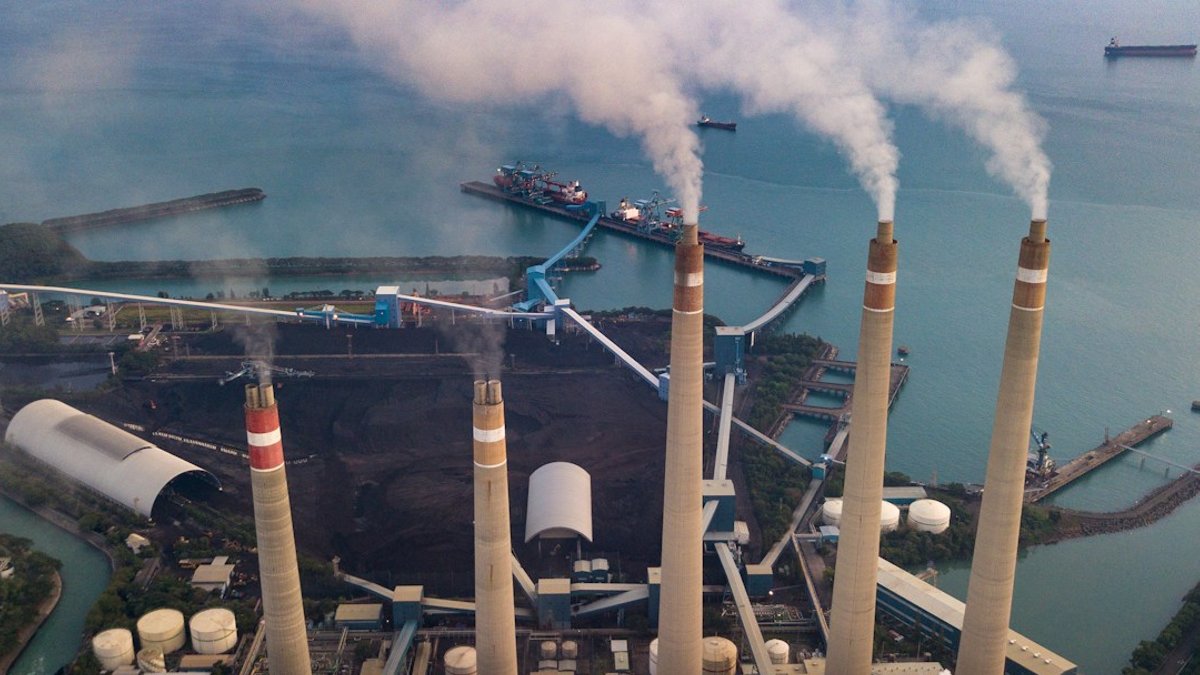
Communities around the Cirebon coal complex in Indonesia’s West Java province have scored a victory after years of resistance to coal expansion. The country’s latest electricity plan has dropped a proposed third plant.
Residents of Mundu Bay, whose lives depend on fishing and salt production, see a fair transition as more than just ending new coal projects or replacing them with other fossil fuels like LNG. What matters to them is being actively included in decisions that impact their daily survival, well-being, and surroundings.
Dwi Rahayu Ningrum, who leads sustainable development at The PRAKARSA and ResponsiBank Indonesia, emphasized that local communities must be engaged from the start—not just as passive participants, but as stakeholders with decision-making authority. According to her remarks to Eco-Business, they should have the power to refuse projects that harm them.
Southeast Asia’s Coal Phase-Out Challenge
Southeast Asia is losing valuable time to align its coal phase-out with international climate targets, as disjointed national policies risk trapping the region in prolonged reliance on fossil fuels, even as funding for new coal projects dwindles.
Although ASEAN nations have adopted coal bans, sustainable finance guidelines, carbon pricing systems, and transition partnerships over the last five years, almost none have implemented enforceable coal phase-out timelines that match the Paris Agreement’s 1.5°C warming limit.
According to the report, Phasing out Coal, Phasing in Justice: Roadmap for financing a responsible regional coal phase-out in Asia, by Fair Finance Asia (FFA) and Influencing Just Energy Transition in the ASEAN (IJET), no Southeast Asian country has yet established a fully Paris-aligned coal phase-out strategy. The study reviewed 15 countries across Asia.
Bernadette Victorio, Program Lead at FFA—a coalition of over 90 civil society groups in Asia pushing for ethical financing—warned that current decisions will decide whether Southeast Asia remains dependent on fossil fuels for decades or proves that coal can be eliminated quickly, fairly, and responsibly.
Coal’s grip on Southeast Asia’s energy systems
Victorio stressed to Eco-Business that the success of a transition isn’t just about shutting down coal plants, but also about reducing inequality by ensuring affected workers, communities, women, and Indigenous groups have genuine rights and influence in the process.
The Intergovernmental Panel on Climate Change has stated that unchecked coal use must decline sharply by 2030 and end entirely by 2040 to stay within the 1.5°C global warming threshold. Yet coal remains a cornerstone of Southeast Asia’s energy mix, supplying roughly 110 gigawatts of electricity capacity as of 2024—a major share of the region’s power supply.
Indonesia’s dominance in the region’s coal sector highlights the difficulty of the task ahead. In 2023, it overtook South Korea to become the world’s fifth-largest producer of coal-generated electricity, while the Philippines ranked 17th globally in coal market size, trailing Vietnam and Malaysia in installed capacity but leading in coal’s share of total electricity production.
Indonesia’s Struggles with Coal Transition
Indonesia has emerged as a policy frontrunner through its Just Energy Transition Partnership (JETP), carbon tax legislation, and sustainable finance taxonomy. But converting those commitments into coal retirements has proved difficult.
Indonesia’s JETP was launched in November 2022 and brought together the government and an International Partners Group of donor countries, with private financing coordinated through the Glasgow Financial Alliance for Net Zero. The partnership has since faced setbacks. The United States withdrew in early 2025, although remaining partners stayed on and pledged financing reached US$21.4 billion by September 2025. Coal plant closures, however, have lagged.
Indonesia’s implementation gap is also evident in its broader coal commitments. President Prabowo Subianto’s 2024 pledge to retire all coal plants by 2040 has not been turned into binding policy and was absent from the country’s Second Nationally Determined Contribution submitted to the United Nations Framework Convention on Climate Change (UNFCCC) in 2025.
The original JETP plan also excluded captive coal from its on-grid power targets, while Indonesia’s sustainable-finance taxonomy still allows some captive coal plants to qualify as transition activities.
Those difficulties were laid bare by the collapse of plans to retire the 660 MW Cirebon 1 coal-fired power plant early.
Operated by PT Cirebon Electric Power and state-owned utility PT PLN, the Cirebon 1 power plant within the wider Cirebon coal complex has become a test case for coal phase-out efforts in Indonesia and across Southeast Asia. Its planned early-retirement deal ultimately fell through in late 2025.
Wahyudin Iwang, Regional Executive Director of the environmental group WALHI West Java, said that even now, following the reported cancellation of the plan, the government has not provided a clear plan of action to the public.
Yuki Tanabe, Programme Director at Japan Center for a Sustainable Environment and Society and Lead of Fair Finance Guide Japan, said the case of Cirebon 1 highlighted the importance of firm government commitments before early-retirement deals advance.
Tanabe stated that the Cirebon 1 coal-fired power plant project, the first under the ETM, has stalled because the Indonesian government ultimately did not agree to it. A host country’s commitment to phasing out coal is essential for the success of the ETM, and Tanabe believes that, in this instance, there was insufficient verification of that commitment during the pre-negotiation stage.
For communities living alongside coal projects, consultation alone does not guarantee participation. Civil society groups say affected people must receive accessible information and have meaningful opportunities to influence decisions, including the right to reject projects that threaten their livelihoods, health, or environment.
The Philippines’ Coal Moratorium Limitations
The Philippines faces its own implementation gap.
The country maintains a moratorium on new greenfield coal plants and has introduced an ETM initiative, also with ADB, alongside a sustainable finance taxonomy. But exemptions allow some coal development to proceed, and the country still lacks a formal national coal phase-out policy.
Despite these measures, the International Energy Agency (IEA) projects the Philippines will remain one of Southeast Asia’s largest coal consumers through 2030. The gap between policy ambition and continued reliance on coal-fired power is clear.
Andrew Leonardo, Project Lead at Fair Finance Philippines, a country coalition under the FFA programme, said the Philippines’ 2020 coal moratorium policy marked a shift in the country’s approach to coal development, particularly by limiting the entry of new greenfield coal-fired power projects. However, the moratorium has a limited scope.
Leonardo added that it does not cover existing and operating coal plants, including those that have already made commitments for expansion and those that serve off-grid or island areas. Implementation remains the central challenge.
Leonardo noted that high upfront costs, weak project bankability, permitting delays, grid constraints, and limited technical capacity continue to slow renewable energy deployment.
Varied Coal Policies Across Southeast Asia
Vietnam has committed to retiring or converting ageing coal plants, while Cambodia has banned new coal plants but has yet to publish a retirement roadmap. Thailand and Laos still lack binding coal exit policies.
A just coal transition requires more than closing power plants. Fair Finance Asia calls for income protection, reskilling, and social protection, alongside respect for land rights and Free, Prior and Informed Consent, transparent grievance mechanisms, and meaningful participation by affected communities.
The human cost of coal dependence
Cirebon shows why those safeguards matter even when the stated goal is early retirement.
The tension is heightened by continued coal development elsewhere in the same complex. Cirebon 2, a separate 1,000 MW coal-fired plant, began commercial operations in 2023.
For nearby communities, the debate over retirement is also about the impacts of plants already operating.
WALHI West Java’s Iwang noted that over the years, pollution from the plant had damaged marine habitats and ecosystems, which meant that fish were no longer as abundant in the areas where local fishers used to fish.
Children were among those most vulnerable to the health impacts, Iwang said, with reported problems ranging from skin irritation and headaches to respiratory and lung conditions.
In at least one case, the doctors confirmed that the health problems the child was experiencing were related to exposure to coal dust from the power plant, Iwang continued.
Dwi of ResponsiBank Indonesia added that communities need access to information and genuine opportunities to participate, so they can make informed decisions and determine their own position when projects are being planned in their area.
Iwang stated that formal consultation does not necessarily amount to meaningful participation. People may be invited to meetings, given presentations, or consulted, but the process does not necessarily provide them with meaningful opportunities to participate or influence decisions.
FFA’s report found that the decrease in international financing for coal projects does not necessarily mean that financing is drying up.
Between 2020 and 2025, the number of coal power plants receiving financing fell from 10 plants comprising 30 generating units to just two plants with seven units. Coal-generating capacity receiving financing also declined from nearly 11,695 megawatts (MW) in 2020 to 2,400 MW in 2025.
But rather than signalling the end of coal investment, the report finds that financing is increasingly changing hands.


