
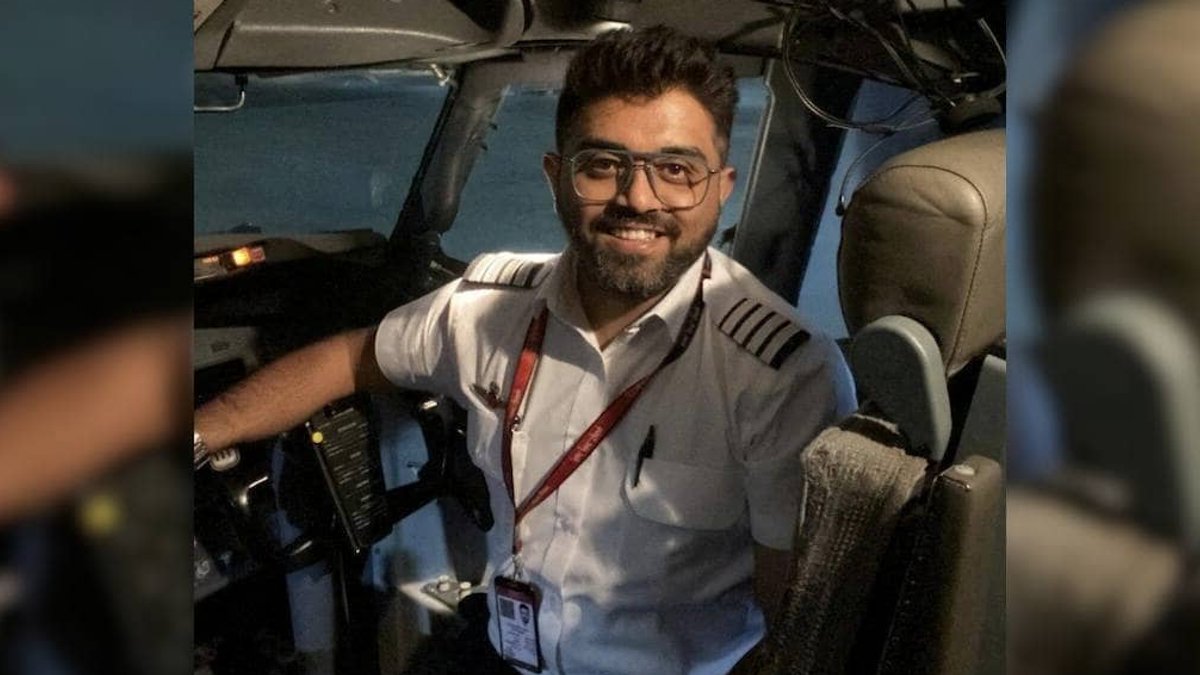
Smit Machchhar, the FlyDubai captain whose actions during a midair crisis averted catastrophe, had never intended to become a pilot. He was studying textile engineering and had already begun a management course when an aviation seminar changed his trajectory. His mother initially opposed the career shift, concerned about the risks, while his father supported the decision, confident he would handle the challenges.
Machchhar’s professional journey took a dramatic turn on March 22, when he was stabbed in the cockpit of a Boeing 737 Max during a flight from Dubai to Tel Aviv. The attack caused the aircraft to plummet 14,000 feet in under 30 seconds, nearing supersonic speed. Despite his injuries, he unlocked the cockpit door, allowing passengers to overpower the attacker. The plane made an emergency landing in Tabuk, Saudi Arabia, with visible damage to the vertical stabilizer.
World leaders quickly recognized his bravery. US President Donald Trump, Israeli Prime Minister Benjamin Netanyahu, and Indian Prime Minister Narendra Modi all praised his heroism. Netanyahu noted that Machchhar was “very badly wounded” yet still fought to unlock the door while fighting for his life. The Indian Embassy in Saudi Arabia later confirmed he was stabilized and transferred to Abu Dhabi for advanced treatment. India’s Ministry of External Affairs described his actions as an act of “valour and courage.”
Read Also: Investors favor domestic economy sectors
From Engineering to Cockpit: An Unlikely Pilot’s Rise
Born in Mumbai, Machchhar began his flying career with SpiceJet before joining FlyDubai in 2022. He has accumulated 9,750 flight hours piloting Boeing single-aisle jets, including the 737 Max, even after its grounding following two fatal crashes in 2018–2019. His training began in New Zealand, his first international trip, after only two prior passenger flights—airfare was prohibitively expensive compared to train tickets.
His first commercial flight, between Bengaluru and New Delhi, was marked less by fear of flying than by the weight of responsibility. Looking back, he said, “relaxing would have been the best option.” Stressing, he added, “is not going to help, at least in this industry.” At SpiceJet, he was among the first pilots to undergo 737 Max training. After the crashes, he flew grounded Max aircraft without passengers, once misleading his father about the plane model to ease his concerns.
Machchhar also mentors students at FlyBy Aviation, a pilot-training academy he became involved with alongside three friends he has flown with since about 2007. These days, he said, he tries to leave aviation behind when he walks out of the cockpit: “Now the kids are there, they want to play with you.”
Read Also: India sees rise in private capital expenditure
Aftermath: Recovery, Investigations, and Lingering Questions
The FlyDubai incident remains under official review. The airline has temporarily halted flights to and from Israel pending further investigation, though it has not disclosed the cause of the altercation. Machchhar’s recovery has been closely tracked by Indian authorities, who confirmed his transfer to Sheikh Khalifa Medical City in Abu Dhabi after stabilization in Tabuk. The Indian Embassy in Abu Dhabi acknowledged local support but did not specify the severity of his injuries beyond describing them as “serious but stable.”
The Boeing 737 Max involved, registered as A6-BXJ, underwent preliminary inspection in Tabuk before being flown to Dubai for further examination. Saudi and UAE aviation authorities shared initial damage reports with Boeing, highlighting structural stress marks on the fuselage and vertical stabilizer. The aircraft’s cockpit voice recorder (CVR) and flight data recorder (FDR) were recovered intact, though their contents remain under investigation by Saudi and UAE authorities, with Boeing providing technical assistance. FlyDubai has grounded the specific aircraft pending the probe, though it has not suspended all 737 Max operations.


